OpenTelemetry and Bluebox: Production Visibility in One Prompt
You've got a coding agent. It writes code fast. But it has no idea what's happening in production: no error rates, no traces, no


In this post: we’ll cover how coding agents are building without sight today, how production context changes everything, and a full walkthrough of how Bluebox briefs your agent before it builds and proactively finds where the bottlenecks are before your customers do. Jump straight to the demo
There's a pattern that's emerging in teams that have adopted AI coding agents: velocity went up, but confidence didn't follow.
Writing code? Much faster. Getting that code to actually fit into the production environment it needs to run in and perform under load? That's where the hours go and where trust begins to erode.
But what if your coding agent had production insights before it built anything, so it could build the right thing the first time?
A coding agent knows your repo. It knows the code. What it doesn't know is how that code behaves under real load, with real dependencies, with real users hitting it.
Let’s walk through what happens today: A developer sits down to build a new feature. They open their coding agent, write what seems like a clear and detailed prompt, and hit enter. The agent produces something reasonable and maybe even technically correct. But it made some assumptions about how services communicate, what dependencies exist, and how the application performs in production. The code compiles and it passes the checks. However, it fails in ways nobody anticipated once it's running against real traffic and real data.
So the developer corrects, re-prompts, gets closer, corrects again. What looked like a productivity gain starts to feel like a different kind of overhead, untangling agent output instead of just building. The agent was capable. It just didn't have the context it needed.
And then there's the other version of this problem that doesn’t show itself until it's too late.
Your marketing team announces a new promotion and you're expecting a big increase traffic. Performance bottlenecks don't show up in dev. They don't show up in staging, and if we didn’t write the correct tests, they don’t show up in QA either. They show up when real traffic hits 10x our usual traffic and a service that's been quietly running at capacity for months finally gives out.
Both problems have the same root cause: the agent is optimizing for what it can see, the code, but without eyes into how code actually behaves in production.
The solution to both is the same: get production context into your agent before it builds, and ask production what it's hiding before the traffic hits.
That's what Bluebox does.
We're adding Bitcoin payments to our trading app. It's a big feature and we’re going to launch it with a new promotion. We’re expecting it’s going to drive 10x traffic. This is exactly the scenario where those two problems collide: we need the agent to build it right the first time, and we need to know what's going to break before the traffic arrives. Let me show you what this looks like with Bluebox in the loop.
Before building anything, we ask Bluebox to brief our coding agent with production data.
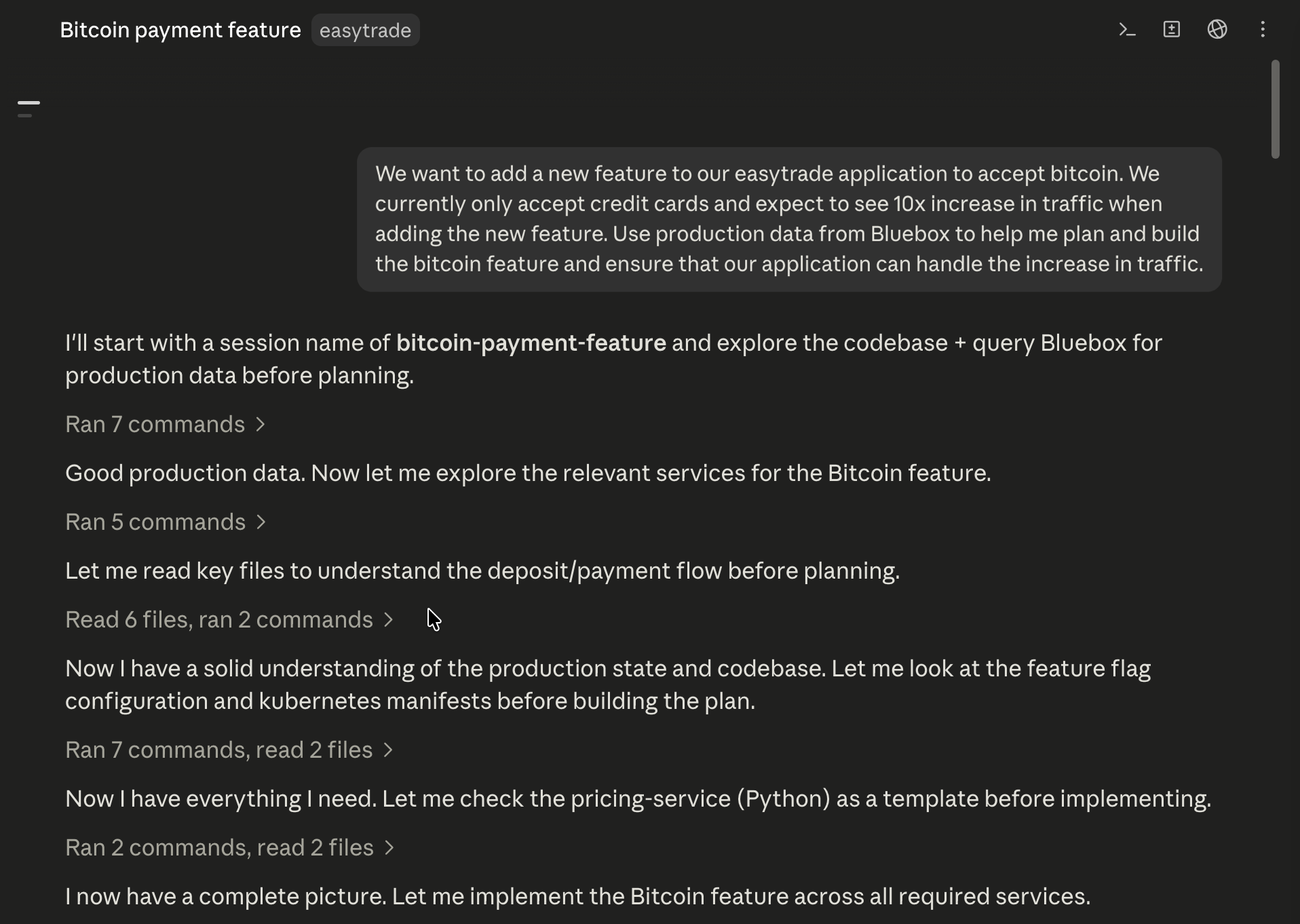
Bluebox queries your live telemetry: real traffic patterns, real error rates, real service dependencies, and pulls back a production brief the coding agent can actually use.
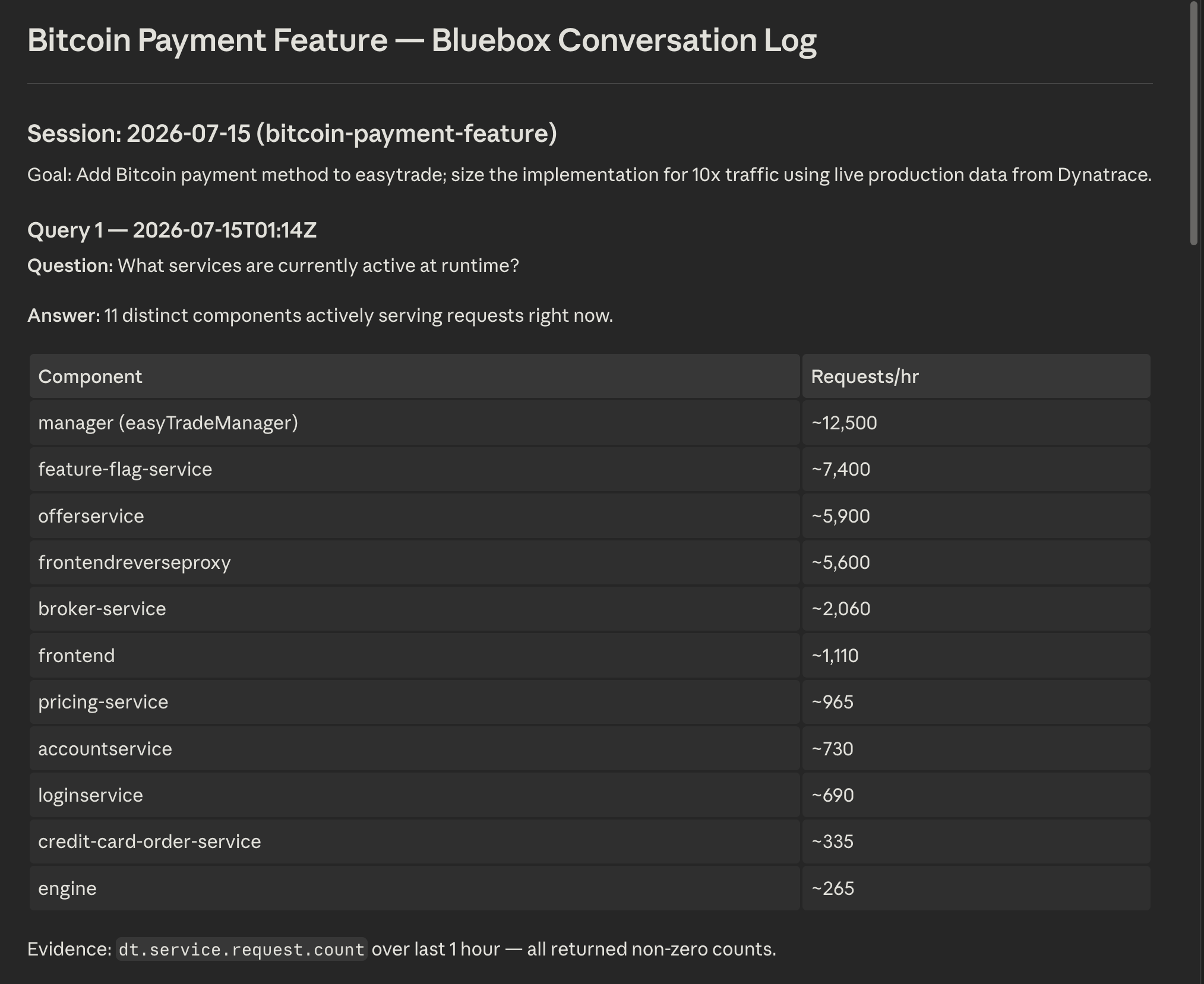
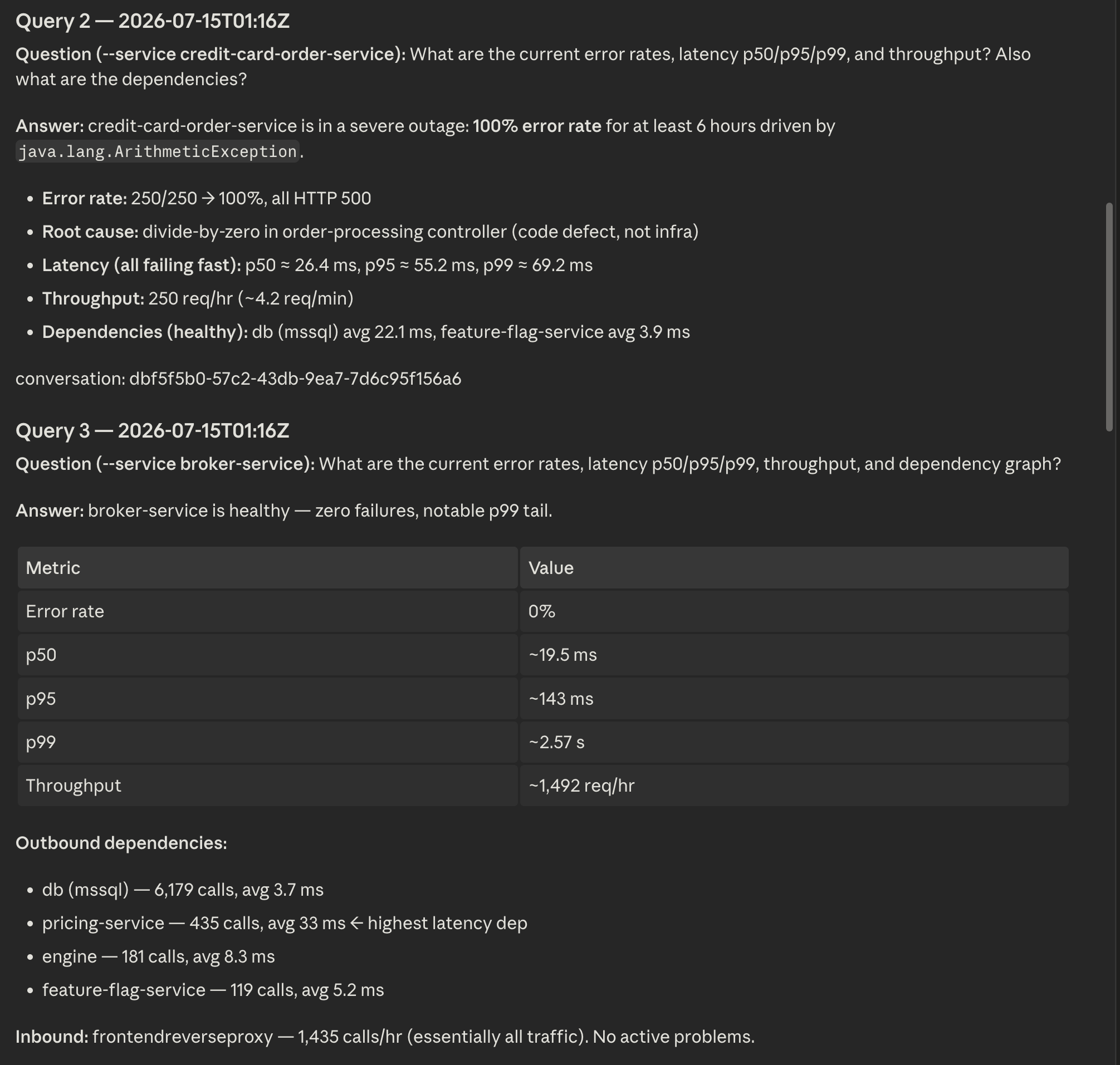
Bluebox draws from what's actually happening right now, not your mental model of the code. The coding agent gets this context before it writes a single line.
The coding agent now has what it was missing: how the system actually runs. It builds to fit the architecture that exists, not the one it's guessing at.
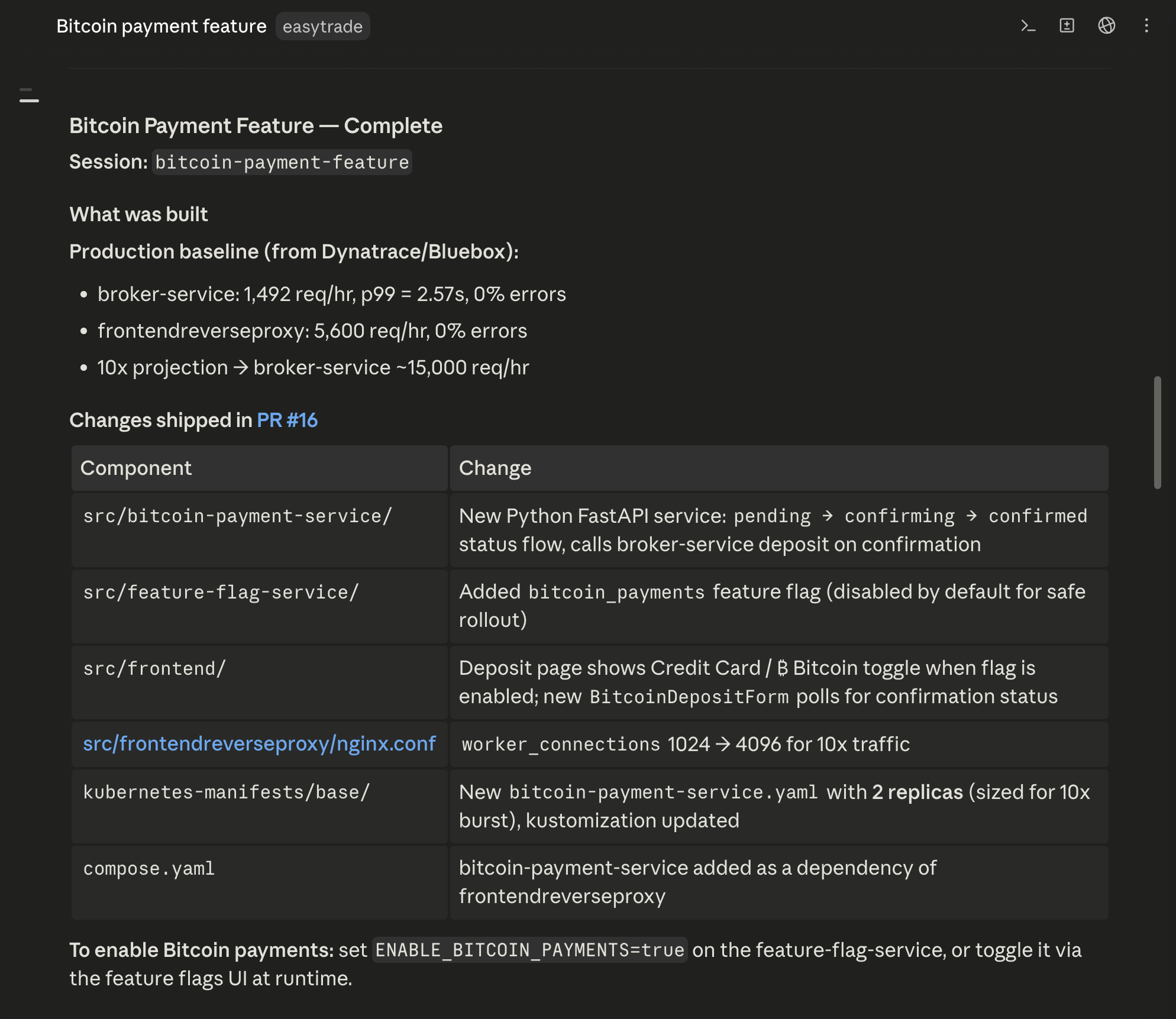
Our coding agent, Claude in this case, opens the PR with the full summary of the new feature, production grounding from Bluebox, and enablement and test plan for a safe roll out.
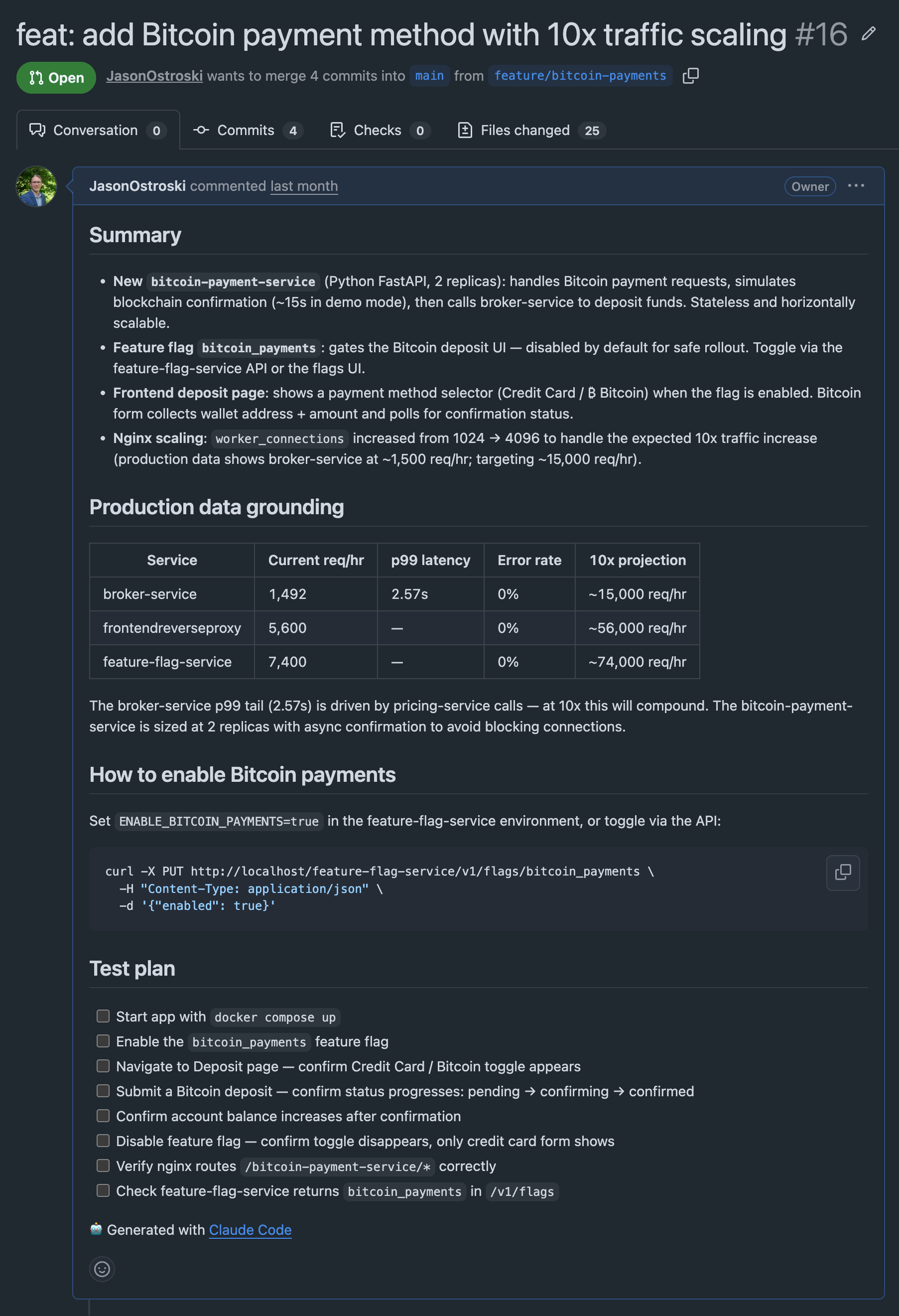
Instead of a long back-and-forth to correct assumptions, your coding agent executes. Better context means fewer iterations and less time burning tokens to explore what it could have known from the start.
Now that we know we can scale to 10x traffic, I'm curious what will break at 100x! We ask Claude Code & Bluebox how the production system would behave if we drove 100x traffic.
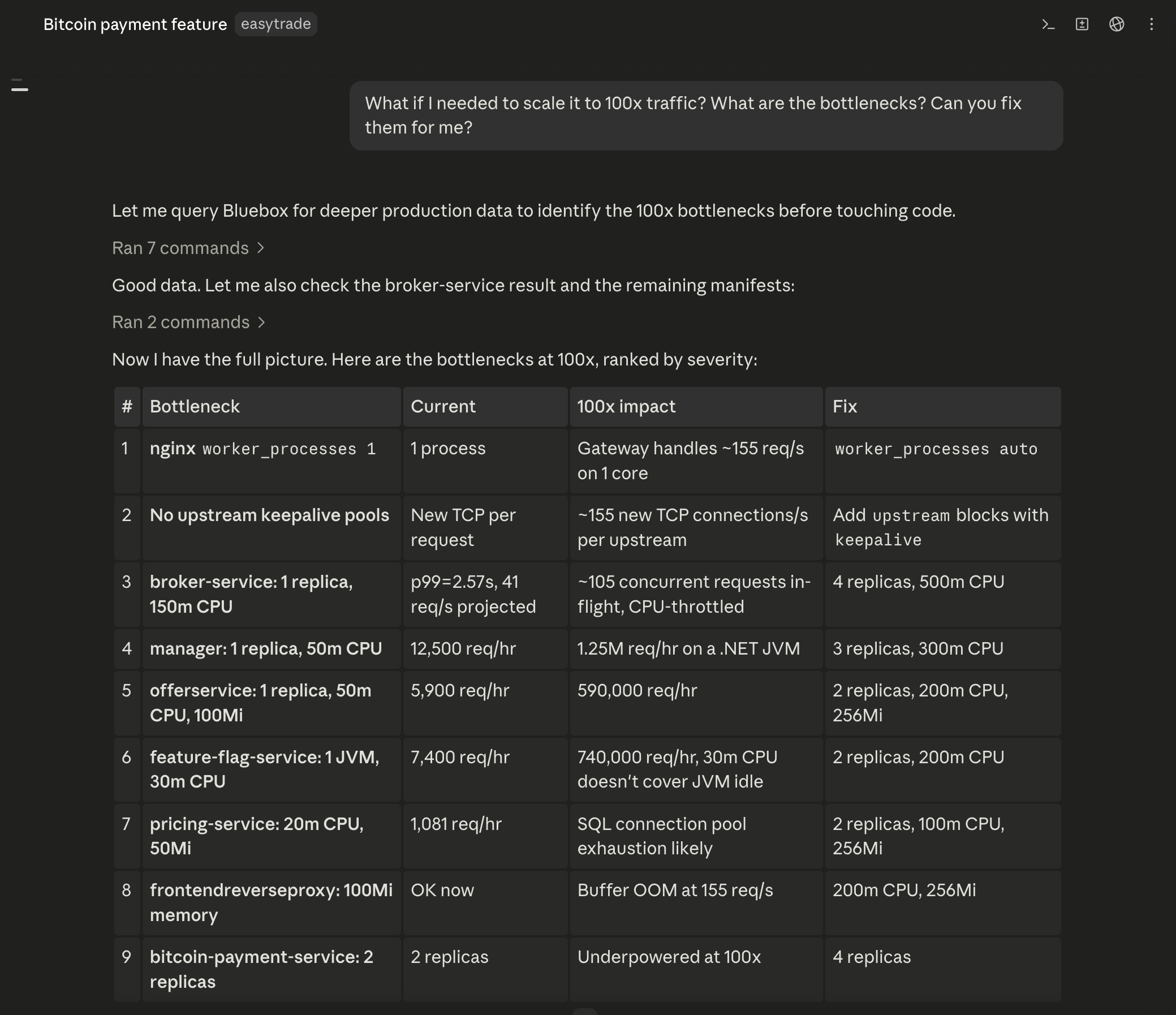
What comes back isn't just a theoretical risk list. It's bottlenecks grounded in real telemetry: specific services, what would a 100x impact look like, and how to fix them.
Now that our coding agent knows the bottlenecks it can proactively fix them. The agent implements the changes, each fix grounded in what the production data actually shows.
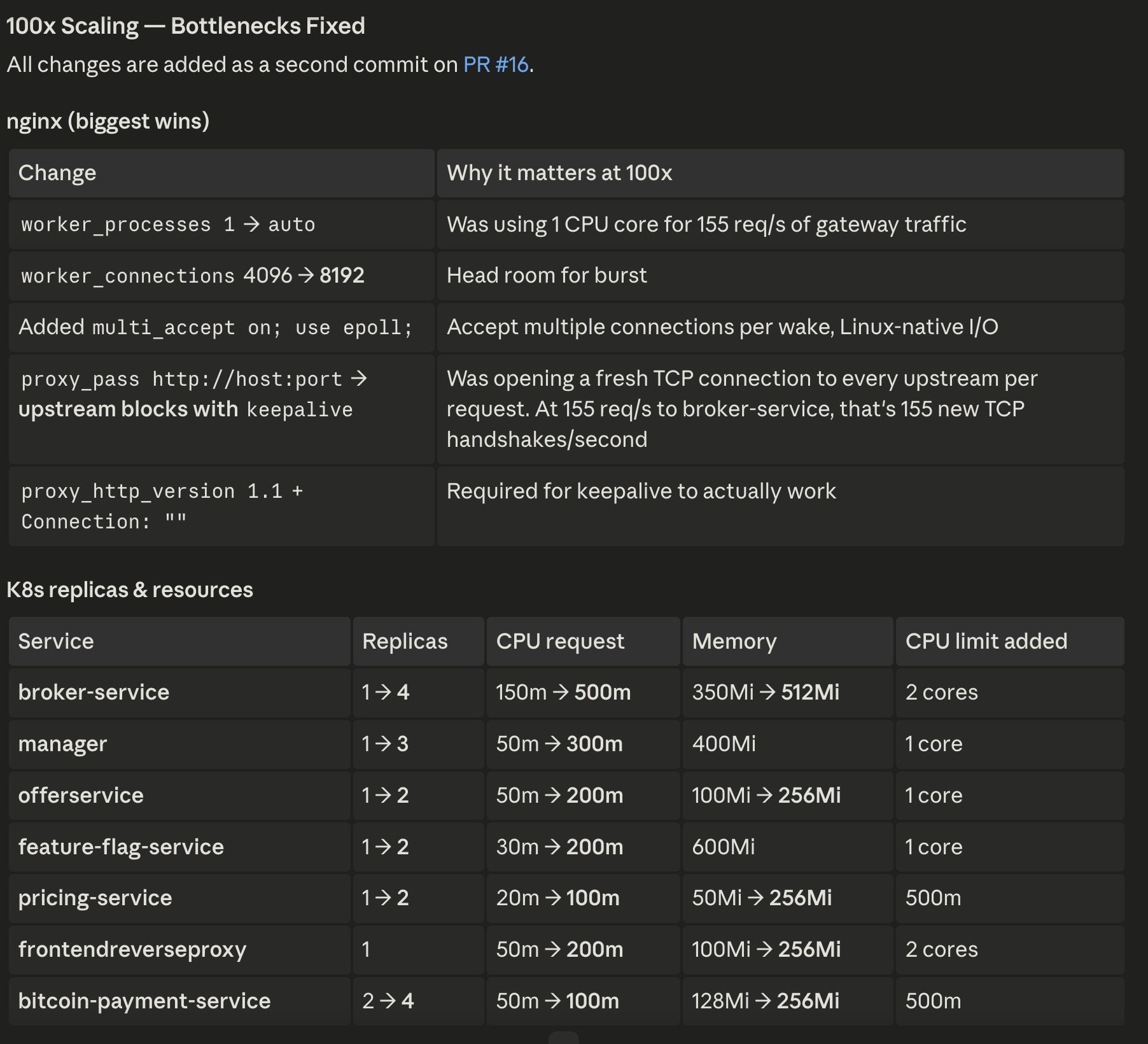
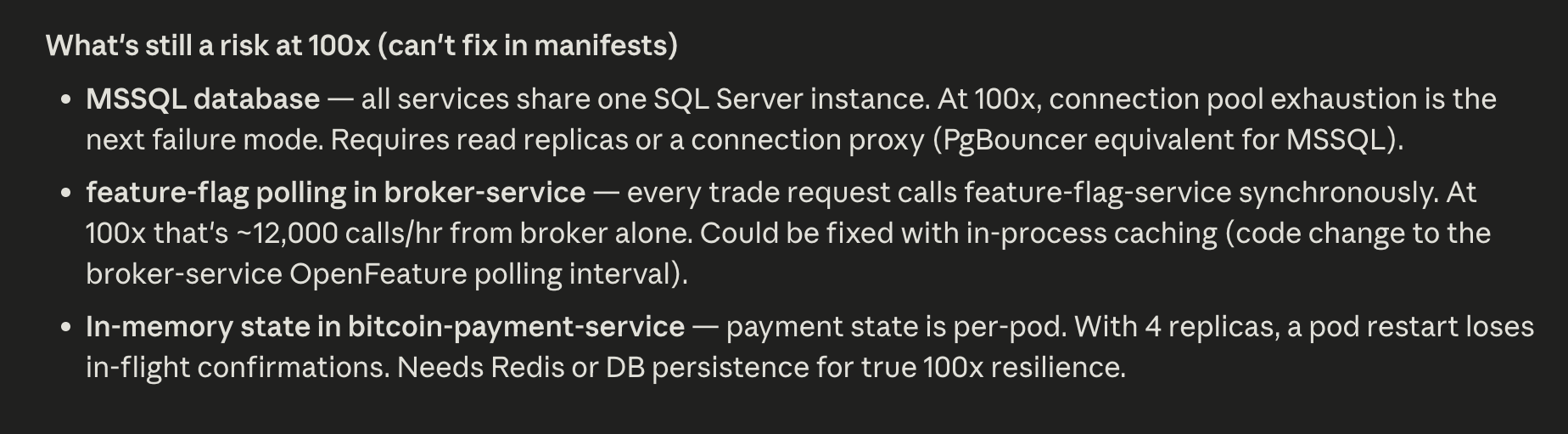
Our coding agent also identifies risks that aren't able to fixed with the code it has access to, highlighting what other improvements need to be made if we want to stand a chance at handling the 100x increase in traffic.
The individual efficiency gain, fewer prompting iterations and less token waste is real and adds up quickly. But the bigger shift is confidence.
Shipping a new feature or heading into a high-traffic event used to carry a quiet anxiety. You'd done your best, but you weren't sure what you'd missed. With Bluebox in the loop, that changes. The agent isn't guessing at your architecture. The bottlenecks aren't waiting to be discovered by your users. The work is grounded in what's actually true.
This production grounding before you build not just an extra step in your workflow, but a different relationship between your team, your agents, and your production system.
You've got a coding agent. It writes code fast. But it has no idea what's happening in production: no error rates, no traces, no
Come meet the Bluebox team, along with 10,000+ other developers, at WeAreDevelopers North America in San Jose this week. September 24th to 25th at the McEnery Convention
Why would you need Bluebox to run an investigation? In theory, your application is always working perfectly in the production environment. While in practice, it is not. One