
Investigation with context and confidence
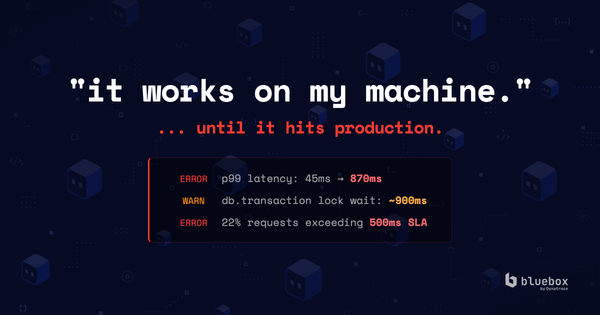
Why would you need Bluebox to run an investigation? In theory, your application is always working perfectly in the production environment. While in practice, it is not. One



I'm Jason Ostroski, Field CTO. I help engineering teams and organizations build their observability and AI practices. Over the past year, one topic keeps coming up in nearly every conversation I have with engineering teams: how do you trust the code your AI coding agents are shipping? This four-part series explores that question, and how Bluebox answers it. Each installment includes demos walking through the product, and we'll be dropping a new post every few days. Stay tuned!
AI coding agents are no longer a novelty, but are a critical part of developers' workflows. Teams across every industry are using Claude Code, Kiro, GitHub Copilot, and Cursor to move at amazing speed. Developers are shipping features in hours that used to take days, burning through backlogs, innovating at a pace that wasn't possible just two years ago.
The speed is real. So is the anxiety that comes with it.
The question I hear most often from engineering teams right now isn't "does this work?". It's: "can I trust what I just shipped?"
That's the problem Bluebox was built to solve.
Your coding agent has never seen your production environment. It knows the code in your repo. It knows what you tell it in the prompt. That's it.
It doesn't know which services are already running close to their limits. It doesn't know how traffic flows through your architecture. It doesn't know what errors are quietly accumulating in your transaction path, or that the feature you're about to ship is going to interact badly with a dependency that's been degrading since last Tuesday.
Production systems are messy, dynamic and ever changing, and full of context that doesn't live in your codebase. And right now, none of that context reaches your coding agent.
It doesn’t have the observability insights of how your application behaves in production. Of course, you can wire up MCP servers and skills to observability backends, but this still takes time and lot of prompting and iteration (and tokens) to get the relevant data to your agent.
The result: code that's correct in isolation, but brittle in production. While developers have always shipped with some level of uncertainty, AI agents have the speed to flood the pipeline. More code, less review, faster merges. And when something breaks at that speed and volume, the cost of being wrong goes up by an order of magnitude.
Bluebox is a helper agent for your coding agent. It connects your AI development workflow to what's actually happening in your live systems, giving your agent the production context it's been missing.
It automatically scans your repos and adds OpenTelemetry, maps your live service topology, monitors production signals continuously, and investigates incidents down to the specific code path that caused them. When it finds something, it opens a GitHub Issue with all the evidence and hands a fix plan to your coding agent.
The short version: Bluebox gives your agents eyes into production so you can ship code you trust.
It works with the coding agents developers are already using (Claude Code and Kiro supported today with many more currently in experimental status) and it doesn't require a new dashboard, a new workflow, or a new way of thinking about your stack. It fits into how you already work and fills in the gap between what your agent can see and what's actually happening when your code runs.
Over the next three posts in this series, I'll unpack each of the core ways Bluebox changes how teams develop with AI agents.
Part 2 : Stop being the translator between production and your agent. I will walk through what happens when Bluebox detects an incident, investigates root cause, and hands your coding agent an evidence-backed fix plan before you've searched a single log.
Part 3: Stop prompting in the dark. I will show you how Bluebox briefs your coding agent with real production context before it builds, so it gets the code and architecture right the first time instead of iterating toward it.
Part 4: Trust it. Ship it. Know it held. We'll trace how Bluebox evaluates releases across the full lifecycle, from non-production testing through to production, so your coding agent ships code you can prove is ready, not just hope is ready.
The underlying shift here isn't about any one feature. It's about what happens when your coding agent stops guessing and has the answers and reasoning it needs from real production data. The code gets better because the agent starts with the right context and knowledge. The iterations get shorter because you’re fixing with real production behavior. And that feeling of "I hope this holds" starts to go away.
That's what we'll dig into across this series.
Why would you need Bluebox to run an investigation? In theory, your application is always working perfectly in the production environment. While in practice, it is not. One
If you've ever shipped a feature and held your breath waiting to see what broke in production or spent hours re-prompting your coding agent just
Coding agents are genuinely good at understanding a local codebase. Point one at a repository and it can read the architecture, trace the data flow, interpret configuration, and
