
Investigation with context and confidence
Why would you need Bluebox to run an investigation? In theory, your application is always working perfectly in the production environment. While in practice, it is not. One



Software is getting built in a fundamentally different way. Over the last year, coding with agents has changed how we design, build, ship, and operate applications, and that change keeps accelerating. The engineer's job has shifted from writing code to orchestrating the agents that write it.
That shift raises the stakes on the part of software development that was always hardest. While writing code was the bottleneck, the bigger challenge was always knowing if you were building the right thing and having the judgment to know if you were on track. That is where products succeed or fail. Now with agents doing the coding, those decisions need to happen faster and are more critical:a wrong call spreads at the speed of the whole fleet.
Coding agents have improved exponentially since even December, but they still work differently from senior developers. An agent takes a specification as text and turns it into code. What it lacks is what every good developer relies on: an understanding of how the system actually behaves when it’s deployed. A production system is never static. Requests flow through it, dependencies fail intermittently, load shifts, behavior emerges that no one designed. An agent that can neither see nor reason about that behavior does not get safer with more autonomy. It just breaks things faster.
An agent needs to understand how a system behaves at runtime, and to investigate that system on demand, to find out why something is happening instead of guessing and checking from the code.
This is where observability has to evolve. Up to now its job was to put the right information in front of a person. People supply the context and format; the tool supplies the data. Agents reverse that. They can absorb far more data than any person, but they lack the context a person carries implicitly, so that context needs to be explicitly provided.
Bluebox gives an agent runtime understanding and context: what the system is, how it should behave, what just changed, what a failure implies, and what to do about it. When a coding agent is about to ship a change, Bluebox understands the architecture the change touches and can tell it what impact that change will have in production. Grounding an agent in how a system actually runs, rather than the code alone, not only measurably improves the quality of its work, it makes it much more efficient
That understanding pays off across the whole lifecycle. Bluebox works with coding agents to design and evolve applications for performance and quality. It helps them debug and tune how a system behaves. It rolls new features out gradually, validates them, and adjusts on the fly. And in operations it catches problems early, finds the root cause, and produces the fix.
The compounding effect is continuous optimization. This has always been the goal, but it was difficult to achieve with limited human time. Teams waited for alerts, resolved incidents, and moved on, while countless opportunities to improve code, performance, reliability, and efficiency were left unexplored and underlying root causes accumulated in the backlog.
Agents change that. Optimization can now run around the clock, and it is realistic to examine every change, not only the ones that turn into production issues. Examining everything carries its own cost in compute, so that cost has to be weighed against the benefit. This is again where observability helps: it provides the context needed to identify which changes matter and where the return justifies the effort. Bluebox uses those production insights to reason deeply when it counts and stay lightweight where it doesn't, ensuring optimization effort is focused on the highest-impact opportunities.
The result is software that does not wait to be told it is broken. It watches itself and improves. Bluebox already runs with Bluebox: it observes its own behavior and opens it’s own issues on how it should be improved.
This launch is not just about a product. It's about fundamentally changing the way software is built. Where automatic remediation and continuous optimization aren't aspirational goals, but reality. It only works if agents working alongside you understand the systems they touch and giving them that understanding is why we built Bluebox.
Our mission is to deliver perfect code, and we look forward to you being a partner on that journey with us at Bluebox.
Please share with us your feedback, use-cases and stories (hello@bluebox.ai).
Why would you need Bluebox to run an investigation? In theory, your application is always working perfectly in the production environment. While in practice, it is not. One
If you've ever shipped a feature and held your breath waiting to see what broke in production or spent hours re-prompting your coding agent just

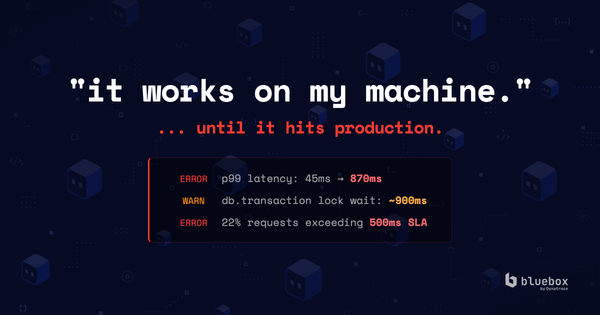
Coding agents are genuinely good at understanding a local codebase. Point one at a repository and it can read the architecture, trace the data flow, interpret configuration, and
