
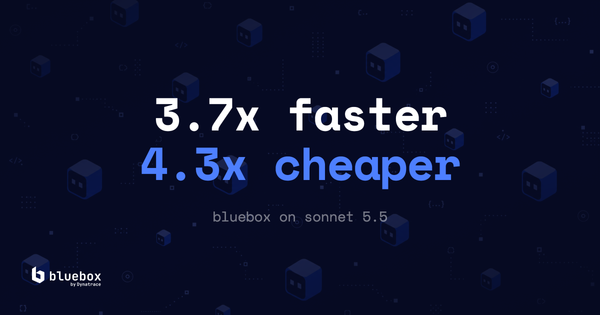
Switching Bluebox to Sonnet 5.5: the eval results
Bluebox runs on Anthropic's Sonnet 5.5 model since October 1. In our evals with SREGym, Sonnet 5.5 diagnosed more problems correctly than Sonnet 5




The Bluebox MCP server is now available to everyone. Connect Claude Code, Cursor, Visual Studio Code, Kiro, Codex, or any other MCP client, and your coding agent can ask Bluebox about production while it works.
A common way for a coding agent to learn about production is to give it a set of query tools and let it work out which service, signals, and time window matter. That basically makes your coding agent a part-time observability engineer. It spends effort fetching telemetry and then reasoning about what it all means.
Bluebox is a full-time observability agent that knows your service topology and investigates production. So, the MCP server doesn’t expose a query language; it exposes an observability expert.
Your coding agent asks a question in plain language. Bluebox conducts the investigation and returns an answer with supporting evidence. Once our agent knows your code, the other knows production. Now they can work together seamlessly.
Say your agent is asked to add a rate limit to a payment webhook endpoint. It has a number in mind and checks it before writing code.
I'm planning a rate limit of 10,000 requests per second on POST /webhooks/payments. Over the last 24 hours, would that have rejected any real traffic?
Bluebox answers from the telemetry:
Yes. The endpoint averages about 1,500 requests per second, but traffic is bursty. The busiest minute ran at 7 times the average, and the busiest second saw 61,000 requests. A limit of 10,000 per second would have rejected deliveries in each of those bursts.
The agent follows up in the same thread: what limit would have been safe?
A limit of 75,000 per second would have cleared every second in the last 24 hours. The bursts are short and the endpoint is close to idle between them, so a token bucket with a burst allowance fits this traffic better than a flat cap.
As you can see, having direct access to production insights during the planning phase can help prevent surprises when the feature is finally released.
It works the same way when something isn't behaving as expected. Ask why an endpoint with a 15 ms median has a p95 near one second, and you get a cause, not a dashboard:
The slow tail comes from an upstream call, not the database. About 40% of requests call the pricing service, and when it is slow the request takes one to three seconds. It isn't a regression: the same tail shows up on each of the last seven days.
Your agent can also read the investigations Bluebox has already run.
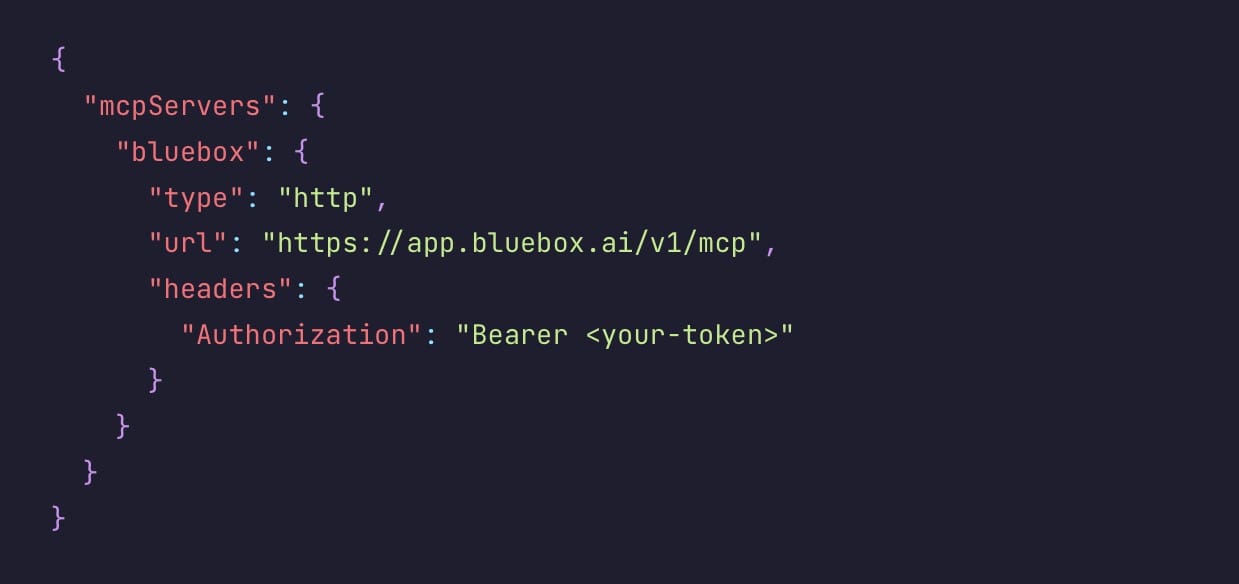
If you don’t have a Bluebox account yet, sign up at app.bluebox.ai/signup. Then go to Settings → Access tokens, select Create token, and pick your agent. Bluebox generates a config with the token filled in. Paste it, restart your agent, and ask something about your environment. The same setup works in GitHub Copilot, Windsurf, OpenCode, Antigravity, and any other MCP client that supports custom request headers. See the setup guide for step-by-step instructions to get started.
Over the next few weeks, we’ll be adding OAuth support, updating our skills to be more MCP-aware, and building plugins for popular coding agents, starting with Claude Code.
Go ahead and connect with your agent to ask about your app. We’re looking forward to hearing your feedback!
Bluebox runs on Anthropic's Sonnet 5.5 model since October 1. In our evals with SREGym, Sonnet 5.5 diagnosed more problems correctly than Sonnet 5
You've got a coding agent. It writes code fast. But it has no idea what's happening in production: no error rates, no traces, no


Come meet the Bluebox team, along with 10,000+ other developers, at WeAreDevelopers North America in San Jose this week. September 24th to 25th at the McEnery Convention